
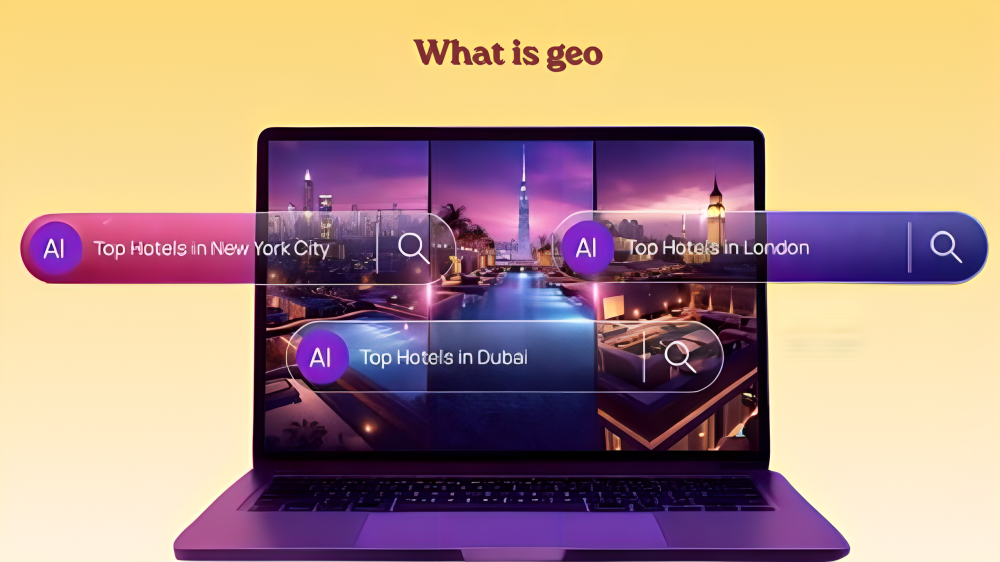
Travel planning has started to look very different from what it was just a few years ago. Many travelers are no longer required to go through dozens of websites before they receive a direct answer to their queries; they now direct AI tools to solutions. It respondents can give personalized suggestions to a traveler interested in a pet-friendly hotel, luxury spa getaway or family-friendly accommodation within a few seconds. This has developed a new challenge and a new opportunity for the hotels that wish to remain visible on the internet.
SEOs continue to be important, yet AI-driven solutions are also taking up significant customer journey portions. Consequently, hotels should be aware of how these systems collect data and select those properties on which they can recommend. Following this, What is GEO is an essential subject among the hotel marketers, property owners and other hospitality firms intending to increase direct bookings.
What Is GEO and Why Are Hotels Focusing on It in 2026?
GEO stands for Generative Engine Optimization. It aims at assisting companies to be listed in searches that use artificial intelligence applications like ChatGPT, Gemini, Claude, Perplexity, and AI-based search engines. Generative engines also do not rely on a list of websites like traditional search engines do, instead offering direct answers. AI systems will analyze information provided by several sources and construct a recommendation when users pose questions.
For hotels, this creates a valuable opportunity. The better opportunity of appearing in those AI-generated responses is a property that exhibits transparent, credible and organized information. Imagine a traveler searching for “the best romantic hotel with countryside views and a spa.” The AI will not randomly select properties. Rather, it will find out those hotels that include such features on a regular basis on websites, reviews, business platforms, and travel websites.
Why Hotels Are Paying Attention to GEO
Research usually leads to hotel bookings. Potential travelers will compare facilities, sites, ratings, and prices way ahead of time before they book. Visibility within those answers proves to be extremely useful when AI platforms are incorporated into that research process.
Hotels that embrace GEO can benefit from:
- Greater brand exposure
- More qualified traffic
- Increased trust signals
- Stronger direct booking opportunities
- Better visibility across AI ecosystems
The goal is not simply to appear online. The goal is to become the recommendation that travelers see first.
What About AEO?
AEO stands for Answer Engine Optimization. It has been used to aid the look of content whenever the platforms have answers directly instead of the search results. Answer engines are voice assistants, featured snippets, smart speakers, AI assistants, and others, where the answers are given greater priority than links. In the case of hotels, AEO is commonly concerned with the generation of content that is simple and gets straight to the point, responding to the questions that guests often have.
Questions frequently asked include:
- Do you allow pets?
- Is breakfast included?
- How far is the hotel from the airport?
- Is parking available?
- What time is check-in?
When a hotel answers these questions clearly, answer engines can understand and use that information more effectively.
GEO and AEO Relationship
Although GEO focuses specifically on generative AI platforms, both strategies share similar principles.
| Area | GEO | AEO |
| Primary Goal | AI recommendations | Direct answers |
| Focus | Generative AI systems | Answer-focused systems |
| Content Style | Context-rich information | Question-focused information |
| Typical Platforms | ChatGPT, Gemini, Claude | Voice assistants, snippets |
Hotels often benefit from implementing both approaches together because they support different discovery channels.
How GEO Is Changing Hotel SEO Strategies
A common misconception suggests that GEO will replace SEO. That is unlikely to happen. Search engines still drive substantial traffic. Travelers continue using Google, Bing, and other search platforms when researching destinations and accommodations.
However, traveler behavior is expanding rather than replacing itself. People now use both traditional search and AI-generated search experiences. That means hotels should view GEO as an extension of their existing visibility strategy rather than a replacement.
SEO helps hotels rank for searches such as:
- Luxury hotel in Manchester
- Family hotel near the Lake District
- Boutique hotel with spa facilities
GEO helps hotels appear when travelers ask AI systems questions using natural language.
| For example, someone may ask:
“Can you recommend a luxury countryside hotel with excellent dining and a spa?” |
The answer generated by AI depends heavily on how well that hotel communicates its strengths across the web.
Why Hotels Need Both Approaches
Hotels that combine SEO and GEO create more opportunities to appear during the guest research journey. Traditional search captures users actively browsing results. AI recommendations capture users seeking direct answers. The strongest digital strategies support both behaviors.
Key Differences Between GEO & SEO
GEO and SEO have similar objectives, but these take place on divergent mechanisms. Rankings are significant to SEO. GEO is about recommendations. SEO measures backlinks, technical performance, relevance of the keywords used, quality of the content and authority. GEO is more concerned with the semantic clarity, relevance to the context, and consistency across various sources.
The distinction becomes easier to understand when comparing them directly.
| SEO | GEO |
| Optimizes for search engines | Optimizes for AI systems |
| Prioritizes rankings | Prioritizes recommendations |
| Relies heavily on backlinks | Relies heavily on trusted information |
| Focuses on keywords | Focuses on context and meaning |
| Generates clicks | Generates mentions and citations |
A Practical Example
Consider two hotels with similar facilities. The first hotel publishes detailed room descriptions, updates amenities regularly, maintains accurate listings, and collects quality reviews. The second hotel provides limited information and inconsistent descriptions across platforms.
Even if both properties rank similarly in search results, AI systems will likely trust the first property more because its information appears clearer and more reliable. That distinction often influences recommendations.
Geo For Hotels: Why the Hospitality Industry Faces Unique Challenges
The hospitality industry depends heavily on trust. Guests want accurate information before making a booking decision. Unlike many businesses, hotels must communicate dozens of details clearly. Room types, check-in policies, dining options, accessibility features, parking availability, and location details all influence booking decisions.
This is where Geo For Hotels becomes especially valuable.
AI systems prefer structured and reliable information. Consequently, hotels with clear information have a lead. A client who questions you regarding the availability of family-friendly rooms wants accurate responses. The AI should know whether or not the hotel has family rooms, children’s facilities or other nearby attractions.
Keeping these details simple to locate and always outlined, the AI platforms will have the confidence to suggest the property.
What Should You Focus On?
Many hotel operators assume GEO requires expensive technology or a complete website redesign. In reality, the foundation starts with content quality and information clarity. Hotels should focus on helping both people and AI systems understand exactly what the property offers.
Clear Property Information
Every important detail should be easy to locate. Guests and AI systems should quickly understand:
- Room options
- Dining facilities
- Parking availability
- Pet policies
- Check-in procedures
- Location advantages
Vague descriptions create confusion. Clear explanations create trust.
Consistent Brand Positioning
Regularity is something that numerous businesses are unaware of. When a hotel talks about itself as a luxury refuge on its web page and looks different on the platforms where people can book their rooms, AI systems will find it difficult to comprehend the positioning of these hotels. Consistency strengthens authority.
Strong Review Signals
Reviews provide real-world evidence of guest experiences. Hotels, whose reviews are detailed, seem credible due to the variety of sources with which the information discussed by AI systems can be verified.
Common Questions Travelers Ask AI Before Booking Hotels
With AI search increasing, people tend to use conversational queries rather than short keywords in their search. The answers to these questions will enable the hotels to generate content that resonates with the intent of the user.
| Traveler Question | GEO Opportunity |
| Which hotel allows pets? | Pet policy pages |
| Which hotel offers free parking? | Amenities section |
| Best family hotel nearby? | Family-focused content |
| Hotel with spa facilities? | Service descriptions |
| Luxury hotel near city centre? | Location optimization |
| Romantic hotel for couples? | Experience-focused pages |
Hotels that answer these questions clearly improve their chances of appearing in AI-generated recommendations.
How to Integrate GEO Into Your Hotel’s SEO Strategy
The most effective approach combines traditional SEO practices with GEO-focused improvements. Hotels do not need separate marketing departments for each strategy. Instead, they should align both efforts around the same goal: helping travelers find reliable information.
On-Page Optimisations
Website content remains the foundation of any GEO strategy. Hotels should organize information logically and answer questions directly. Detailed FAQ sections often perform exceptionally well because they mirror the conversational nature of AI queries. Clear room descriptions, facility summaries, and local area guides also help AI systems understand property offerings.
A well-structured hotel website should include:
- Clear amenity descriptions
- Accurate contact information
- Updated pricing details
- Frequently asked questions
- Local attraction information
The easier the information is to understand, the easier it becomes for AI platforms to reference it.
Off-Page Optimisations
AI platforms rarely rely on a single source. Instead, they compare information from multiple locations across the web. That is why external visibility matters. Travel blogs, review websites, tourism directories, booking platforms, and local publications all contribute to digital authority.
The second major benefit of Geo For Hotels comes from this wider ecosystem. Hotels that maintain consistent information across external platforms often develop stronger trust signals. Guest reviews also play an important role. Authentic reviews provide context that AI systems use when evaluating hotel quality and guest satisfaction.
Technical Optimisations
Technical performance supports every other optimization effort. A slow website creates barriers for both users and search systems.
Hotels should prioritize:
| Technical Factor | Why It Matters |
| Mobile usability | Most travel searches occur on mobile devices |
| Fast page speed | Improves user experience |
| Structured data | Helps systems understand information |
| Clean navigation | Improves accessibility |
| Accurate metadata | Strengthens content understanding |
Schema markup deserves special attention because it helps AI systems identify critical hotel details such as amenities, reviews, addresses, and booking information.
Real-World Example of GEO in Action
Suppose a small boutique hotel was in a small place close to a well-known holiday spot in the countryside. The hotel revised its frequently asked questions, enhanced descriptions of rooms, promoted guest reviews by the guests in a detailed manner and made sure that business details were not confused among booking websites.
When the property saw an improvement in branded search visibility and direct traffic over several months. Although numerous aspects led to the expansion, there were easier to comprehend the information provided by the clearer information, which helped search engines and AI systems to grasp what made the hotel special.
The Future of SEO, GEO and AI Search for Hotels
The search behavior is additionally changing and the hotel needs to change. Sophisticated AI systems are up and coming. The conversational search is becoming more comfortable for travelers. Therefore, the sources of recommendations made by AI are likely to have a greater impact on the booking decision within the next several years. That does not mean traditional search disappears.
Instead, successful hotels will build visibility across both environments. The properties that thrive will focus on clarity, consistency, authority, and genuine usefulness. They will answer guest questions effectively and maintain accurate information wherever travelers search. The hotels that wait too long may discover competitors occupying valuable AI-generated recommendation spaces.
AI Search and Travel Trends Worth Watching
AI-assisted travel planning is an area of growing interest in the hospitality industry. Conversational searches are gaining popularity with users as they compare different destinations, accommodations, and local experiences.
| Trend | Impact on Hotels |
| Growth of AI search | Higher importance of GEO |
| Conversational queries | Need for natural language content |
| Review-based recommendations | Stronger focus on reputation |
| Mobile travel planning | Better mobile experiences required |
| Personalized search | More detailed hotel information needed |
These trends suggest that hotels should prepare for a future where AI recommendations influence a larger share of booking decisions.
Getting Started With GEO Without a Large Marketing Budget
Many hotel owners feel overwhelmed when they first encounter GEO. The given reaction is excusable as the subject matter seems to be technical on the surface. Luckily, most hotels already have a great deal of the information they require. Begin by reviewing your site. Make sure that room descriptions are up to date and understandable. Update FAQs. Make sure that business information is unified across the booking services and review sites.
Then look at the reviews of the guests. Request extensive comments on contented guests since such comments tend to build trust. Many practical first steps can be more effective than pursuing advanced strategies or going directly to crucial tactics. Small improvements made consistently usually outperform major changes made once.
Final Thoughts
The question is no longer whether AI will influence travel decisions. That shift is already happening. Travelers want quick answers, customized suggestions, and trustworthy details. Hotels that offer such things evidently will have a greater opportunity of gaining visibility where future reservation decisions start.
With more hotels embracing AI-enhanced travel planning capabilities, the hotel industry should not rely on search rankings that are more modern. It grows more and more to be a matter of clarity with which a property brings awareness to its amenities, experiences and its exclusive value, as it reaches more and more areas of the web. By practicing both good SEO tactics and What is GEO-targeted content strategies, the hotels will be at a greater advantage of gaining visibility, trust and subsequent bookings in an AI-based search index.
FAQs
Q1. What is geo in hotel marketing?
GEO stands for Generative Engine Optimization, which helps hotels appear in AI-generated recommendations and answers.
Q2. How does GEO differ from traditional SEO?
SEO focuses on search rankings, while GEO focuses on helping AI systems recommend and reference your hotel.
Q3. Why is GEO becoming important for hotels?
More travelers use AI platforms during trip planning, making AI visibility increasingly valuable.
Q4. Does GEO replace SEO?
No. GEO complements SEO and works best alongside strong traditional search optimization.
Q5. Can small hotels benefit from GEO?
Yes. Clear information, quality reviews, and consistent branding can help properties of any size improve visibility.
Q6. What platforms use GEO principles?
ChatGPT, Gemini, Claude, Perplexity, and AI-powered search experiences all rely on similar concepts.
Q7. How long does GEO take to show results?
Results vary, but consistent improvements in content quality and authority typically build stronger visibility over time.
Q8. Is schema markup necessary for GEO?
Schema markup is not mandatory, but it helps AI systems understand hotel information more accurately.
Read More Blogs: Meta Ads For Hotels: Building Demand Beyond Direct Bookings