
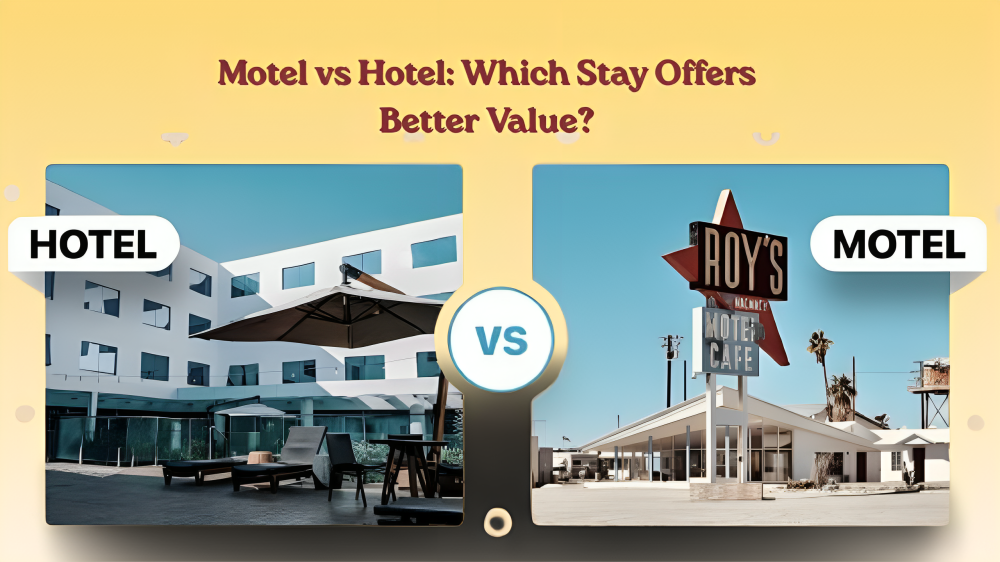
Booking accommodation seems easy until you start comparing different options. Travelers would seek a motel vs hotel as they are both places to stay, but the experience can be vastly different. A road trip passenger can be interested in high comfort and low cost, whereas a vacationing family can be interested in comfort and additional services.
The option influences your budget, comfort, location and the whole experience of traveling. Other individuals have the automatic booking of the lowest rate of the accommodation only to realize in the future that this place will not accommodate the facilities required. Some do not even utilize the luxury amenities that they pay. Knowing the differences between motels and hotels will allow you to make a wiser choice before giving your money away.
The simplest thinking about this is the following: motels are planned by individuals who are on transit through a destination and hotels are typically meant by individuals who would prefer to spend time in a destination. Once you understand that distinction, the comparison becomes much easier.
What Is a Motel?
A motel is a type of accommodation primarily designed for travelers arriving by car. It is a combination of “motor” and “hotel”, which gave the name of this word. Majority of the motels are situated in proximity to highways, major roads and travel routes, meaning that they are easily accessible to individuals requiring a temporary place to stay overnight.
In contrast to conventional hotels, motels tend to have exterior rooms and access to the parking area. Visitors are able to park near their room, spend less time loading and unloading, and then move on to their destination with the least trouble. This basic design was at its height when road travel was gaining popularity and it continues to be one of the greatest benefits of the motels in the present day.
What Is a Hotel?
A hotel is a business lodging facility that provides accommodation and a variety of services and facilities. Hotels serve different types of travelers who might include tourists, business people, families, and long-term guests.
Hotels have the most common centralized reception, interior corridors, housekeeping services and recreational facilities. By the nature of the property, guests can also have access to restaurants, fitness facilities, swimming pools, conference rooms, and a concierge. Hotels not only concentrate on accommodation, but also on hosting comfy experience to its guests.
Motel vs Hotel: Understanding the Basic Difference
The discussion around motel vs hotel often starts with a simple question: aren’t they both places to sleep? Technically, yes. However, their purpose, design, and target guests differ significantly.
Hotels are of a kind thousands of years old. Antique inns served meals and accommodations to merchants who travelled long distances. In the course of time, these inns were transformed into contemporary hotels serving tourists, businessmen and women, as well as families.
Motels arrived much later. The term combines the words “motor” and “hotel.” They became popular when automobile travel expanded across America. Drivers needed affordable places to stop for a night before continuing their journey.
The table below highlights the most noticeable differences.
| Feature | Motel | Hotel |
| Main Purpose | Short stays for motorists | Business and leisure stays |
| Location | Highways and roadsides | Cities and tourist areas |
| Parking | Outside room | Separate parking area |
| Amenities | Basic | Extensive |
| Building Type | Usually 1–2 floors | Multi-story buildings |
| Average Cost | Lower | Higher |
While these distinctions still apply today, some modern properties blur the line between the two.
Motels: Roadside Accommodation Designed for the Motor Tourist
Motels focus on convenience. Their entire layout serves travelers arriving by car. The main characteristic of most of the properties is that they have exterior room entrances, which gives the possibility of having a guest park in front of his or her room. The design ensures a fast and easy check-in and check- out. The revisitors will be able to check in and out and proceed on their business without having to go through large lobbies or a number of floors to do so.
Most tourists prefer staying at motels due to their reasonable price. A person who drives through more than a few states probably requires a clean room, a nice bed, and a hot shower. Additional amenities might not be important for a one-night accommodation.
A typical motel attracts:
- Road trippers
- Budget travelers
- Truck drivers
- Families in transit
- Short-stay business travelers
Motels also have competitive rates for their rooms because of the lower operating costs. They frequently pay less and still make profits because they have fewer employees and offer fewer amenities. There is another benefit of accessibility. One can save time and effort because it will be possible to park right outside the room, particularly when one needs to transport someone with some luggage or children. Someone visiting at an unsociable time at the end of a long drive usually values the gift of being able to pull up right on the door to the room. A little perquisite can make an overnight stay a lot easier.
Hotels: Accommodations for Every Traveler, in Every Destination
Hotels serve a much broader audience. In contrast to motels, they usually become a part of the travel experience and not a simple provision of a place to sleep. Visitors can waste a lot of time at the hotel. The stay often includes restaurants, fitness centers, pools, spas, conference rooms and concierge services. There are also various forms of hotels. There is a big difference between a luxury resort and a budget hotel, but they are nevertheless of the same category.
Common hotel types include:
- Business hotels
- Boutique hotels
- Luxury hotels
- Resorts
- Extended-stay hotels
- Budget hotels
Hotels appeal to a wide range of customers since the needs of the customers vary. Enterprise people can put more importance on the meeting room and the stable Wi-Fi. Families tend to seek bigger rooms and recreation amenities. Vacationists tend to pay attention to location and comfort.
For example, a couple spending five days in New York City may prefer a hotel because it places them near attractions, restaurants, and public transportation. The convenience often justifies the higher cost. Families often discover that hotel amenities become more valuable during longer stays. Features such as swimming pools, restaurants, and housekeeping can save both time and effort throughout the trip.
How Modern Travel Trends Are Reshaping Motels and Hotels
Many travelers no longer choose accommodation based only on price. They also take into account convenience, technology, guest reviews, and experience as a whole. The changing expectations have altered how hotels add mobile check-ins, associate room keys and personalized services to stay up to date. Meanwhile, a lot of motels were renovated and recently they provide a modern interior, better facilities and an online experience in booking rooms. The two types of accommodation are changing in efforts to impress a new breed of travelers as travel trends keep changing.
Motel vs Hotel for Family Vacations, Business Trips, and Road Travel
All passengers are not equal. A family holiday demands different amenities compared to a business trip or a drive. That is why knowing about which accommodation would fit your style of travel can make you smarter when making a booking choice.
| Traveler Type | Better Choice | Reason |
| Road Tripper | Motel | Easy highway access |
| Business Traveler | Hotel | Meeting facilities and Wi-Fi |
| Family Vacation | Hotel | Amenities and larger rooms |
| Budget Traveler | Motel | Lower room rates |
| Long-Term Guest | Hotel | Better facilities and services |
For example, a family spending five days near a theme park may appreciate hotel amenities such as pools and on-site dining. Meanwhile, a traveler driving across several states may prefer the convenience and affordability of a motel.
Difference Between Hotel and Motel: Key Factors That Set Them Apart
Many travelers still struggle to identify the difference between hotel and motel when browsing booking websites. Three factors usually provide the clearest answer.
1. Location and Accessibility
The property type can be immediately disclosed by location. Motels are normally found along highways, major roads, and routes. They are meant to cater to individuals who are requesting travel between destinations. Hotels tend to be located in more preferred sites. They are often located around airports, city centers, beaches, convention centers and tourist attractions. A visitor who takes a week to explore an urban area is more likely to be at an advantage with a hotel. A person who is on a journey all the way through the country might decide to stay in a motel since access to the highway is easy.
2. Room Sizes and Property Layouts
The physical design also creates a noticeable difference. Most motels feature one or two floors. Guests access rooms directly from outdoor walkways, and parking sits close to the accommodation.
Hotels generally include:
- Interior hallways
- Central reception areas
- Elevators
- Multiple floors
- Larger common spaces
| Layout Feature | Motel | Hotel |
| Exterior Entry | Yes | Rare |
| Central Lobby | Limited | Common |
| Multiple Floors | Rare | Common |
| Elevator Access | Rare | Common |
This design reflects the original purpose of each property type.
3. Amenities and Guest Services
Amenities create perhaps the biggest difference. Motels focus on necessities. Hotels focus on experiences.
A standard motel may provide:
- Wi-Fi
- Parking
- Air conditioning
- Television
Hotels often include:
- Restaurants
- Pools
- Fitness centers
- Room service
- Concierge services
- Meeting rooms
- Business centers
This is where the difference between hotel and motel becomes most obvious. Travelers paying for a hotel generally expect more than just a room.
Motel vs Hotel: Cost Comparison
Price often influences booking decisions. Although motels are usually less expensive, the difference between cheapest and best value does not necessarily imply the same thing. Tourists can think over what amenities they really require when staying.
| Expense Factor | Motel | Hotel |
| Room Rate | Lower | Higher |
| Parking | Usually Free | May Cost Extra |
| Amenities | Limited | Extensive |
| Dining Options | Rare | Common |
| Business Facilities | Limited | Available |
A motel can prove to be an excellent value to a traveler who stays over. Having a guest who has a week may spend more time in the hotel enjoying the extra services provided. The most inexpensive room is not necessarily the best. Tourists who will take several days to reach their destination will usually consider that putting up in a hotel with extra facilities is worth the extra money each night.
Pros and Cons of Staying in a Motel
Every accommodation type has strengths and weaknesses. Motels offer affordability and convenience, but they may lack the facilities some travelers expect.
Advantages
- Lower room rates
- Easy parking access
- Quick check-in and check-out
- Convenient highway locations
Limitations
- Fewer amenities
- Smaller common areas
- Limited dining options
- Fewer recreational facilities
Pros and Cons of Staying in a Hotel
Hotels provide more services and amenities, making them attractive for longer stays and destination-focused trips.
Advantages
- Greater comfort
- More amenities
- Better security features
- Convenient locations
Limitations
- Higher prices
- Parking fees at some properties
- Larger properties can be less convenient for quick stays
Common Misconceptions About Motels and Hotels
Many travelers do make assumptions concerning motels and hotels yet they have no idea the extent to which the hospitality industry has evolved. Although certain differences are still expressed, there are also several common beliefs that cannot be considered accurate anymore.
- It is a common belief that all motels are old-fashioned, but most of the contemporary motels have updated rooms and have improved rooms and facilities.
- Certain tourists believe that all hotels offer luxury services; nevertheless, there are numerous budget hotels that simply offer some basic housing.
- The assumption that motels are unsafe is normally held by people, yet the level of safety lies more with the management and location rather than the type of property.
- The other myth is that hotels are always preferable to other alternatives. As a matter of fact, motels may be more affordable when it comes to short-distance journeys and overnights.
The decision on whether to stay at a motel or a hotel ought to be based on your travelling needs and not on archaic beliefs.
How Traveler Expectations Influence Motel and Hotel Operations
The distinction between hotels and motels extends beyond guest preferences. The property owners should also know the impacts of these differences on operations and profitability. The expectations of guests are unbelievable. Customers at motels are quite conscious of prices and comfort. The expectations of the hotel guests are often higher with regard to service standards and facilities. Understanding these expectations allows the owners to better position their properties in competitive markets.
Marketing Strategies That Work for Hotels and Motels
Marketing strategies often reflect the property’s identity.
Hotels frequently promote:
- Luxury experiences
- Exclusive amenities
- Loyalty programs
- Business facilities
- Premium locations
Motels typically focus on:
- Competitive pricing
- Convenience
- Easy parking
- Highway accessibility
An advertisement for a luxury hotel can emphasize the spa and fine cuisine. Clean rooms and low prices are the common topics of a motel ad. Each of them can be effective provided that they are addressed to the correct audience.
What Each Label Means for Pricing Strategies
Pricing plays a major role in profitability. The reason is that motels tend to keep the room rates lower, as they do not have many facilities and end up having fewer employees. Before making a reservation, their guests usually shop around. The pricing models utilized in hotels are more sophisticated. Room rates are often determined on a demand and season-based basis, events, and occupancy rates.
As an example, using a hotel outside a convention center, one might charge higher during a large-scale convention. The variance in a roadside motel is normally reduced since convenience is its greatest selling point. Effective managers keep track of demand trends and modify the prices.
Smart Property Management Strategies That Increase Occupancy
Strong property management influences guest satisfaction, online reviews, and repeat business. Being in charge of a motel or a hotel, managers should pay attention to the provision of the same quality. Reviews are usually read by the travelers before booking. A house that is clean, responsive and provides reliable service will tend to do better than fellow houses.
Modern management also involves:
- Revenue optimization
- Staff training
- Reputation management
- Guest communication
- Technology integration
Properties that consistently meet guest expectations often achieve stronger occupancy rates and higher revenue.
Are You Maximizing the Potential of Your Property?
Success does not depend solely on whether a property operates as a motel or hotel. It is determined by the effectiveness in which the management comprehends its target audience. This is where a motel can flourish by providing superior cleanliness, convenience and value. It is possible to make a hotel successful by establishing great guest experiences and providing a service that is trustworthy. The best of properties seldom attempt to be all things to all. Rather, they concentrate on the most important things for guests and implement such a strategy in a regular manner.
Which Option Is Better for Your Next Trip?
There is no universal winner in the motel vs hotel debate. The best choice depends on your travel goals, budget, and expectations.
Choose a motel if you:
- Need a short overnight stay
- Want to save money
- Are traveling by car
- Prioritize convenience
Choose a hotel if you:
- Plan a longer stay
- Want additional amenities
- Need business facilities
- Prefer a destination-focused experience
Making the right choice often comes down to understanding what you value most during your trip.
Conclusion
The motel vs hotel comparison becomes much simpler once you understand the purpose behind each option. Motels focus on convenience, affordability, and quick access for travelers on the move. Hotels offer broader services, more amenities, and greater comfort for longer stays. Neither option is automatically better. The right choice depends on your travel goals, budget, and expectations.
If you only need a comfortable place to rest during a road trip, a motel may provide excellent value. If you want dining options, recreational facilities, and a destination-focused experience, a hotel will likely be the better investment. The smartest travelers match the accommodation to the trip rather than assuming one type always offers the best value.
FAQs
Q1. What is the biggest difference between a motel and a hotel?
Hotels provide more amenities and services, while motels focus on affordable roadside accommodation.
Q2. Is a motel safer than a hotel?
Both can be safe when properly managed, although hotels often provide additional security features.
Q3. Why do motel rooms face the parking lot?
This design allows travelers to access rooms quickly and unload luggage conveniently.
Q4. Can a motel be luxurious?
Yes. Many renovated boutique motels now offer stylish accommodations and upgraded facilities.
Q5. Can a motel be better than a hotel?
Yes. For short road trips and overnight stops, many travelers prefer motels because they offer easier parking access, lower costs, and faster check-ins.
Q6. Which option works best for a one-night stay?
Most travelers find motels more convenient for short overnight stops because of their accessibility and lower cost.
Read More Blogs: