
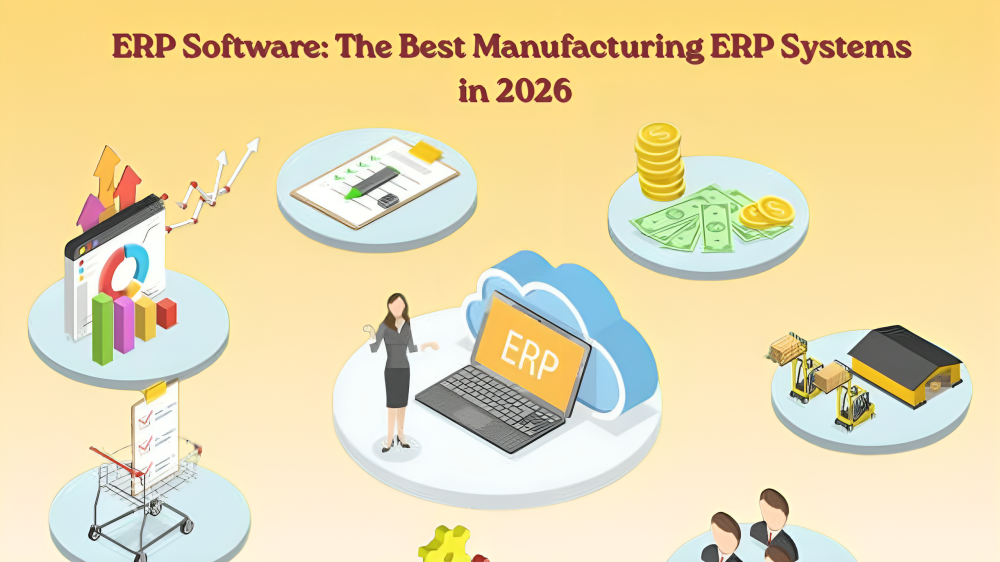
The production industries are subject to high competition, long supply chains, orders from customers subject to rapid changes and so on. Due to these issues businessman now more than ever is turning towards ERP Software that helps in the effective working of businesses. An ERP Software is a higher level ERP system which combines finance, inventory, production, HRM, and customer info all into a single application. This results in more organizations having a real-time view of the operations and being able to make better decisions quicker.
Moreover, manufacturing facilities are constantly evolving, with the introduction of automation, AI, and digital transformation. Hence, choosing the ERP Software becomes of paramount importance for companies aiming to successfully scale their operations. This in-depth article delves into the top manufacturing ERP Software options for 2026, their capabilities, advantages, and the selection process for finding the ideal software for your business.
What is ERP Software?
ERP Software is a business management system that integrates various business processes in the enterprise. As opposed to handling different aspects of customer management, inventory, production and accounting using separate tools, companies deal with all of them utilizing a unified system ERP Software.
Companies that provide manufacturing products are especially helped by ERP Software, since they have various factors that are moving. The various functions of production planning, warehouse management, procurement and quality management must be integrated to a sophisticated level. So, in case that any firm deploys modern ERP Software solutions, they will enhance the operational effectiveness, and this will cause a disappearance of data silos.
Top 10 Manufacturing ERP Software Systems for 2026
The following table lists some of the top ERP Software platforms that are suggested from industries in manufacturing for 2026. The platforms were assessed on the three main dimensions of scalability, features, integration and performance.
| ERP Software System | Deployment Type | Best For | Key Features |
| NetSuite ERP | Cloud | Small to mid-size manufacturers | Financial management, CRM, inventory |
| Epicor Kinetic | Cloud / On-Premise | Mid-market manufacturers | Production control, analytics |
| Cetec ERP | Cloud | Affordable ERP adoption | CRM, inventory, quality management |
| DELMIAWorks | Cloud / On-Premise | Process manufacturing | ERP + MES integration |
| SAP S/4HANA | Cloud / On-Premise | Large enterprises | AI, machine learning, analytics |
| Acumatica Cloud ERP | Cloud | Growing businesses | Flexible licensing, IoT support |
| QAD Adaptive ERP | Cloud | Global manufacturers | AI-driven automation |
| Infor CloudSuite Industrial | Cloud / On-Premise | Large enterprises | Smart manufacturing tools |
| Global Shop Solutions | Cloud / On-Premise | Small-mid manufacturers | Shop floor management |
| Microsoft Dynamics 365 Business Central | Cloud | SMB manufacturers | Finance, CRM integration |
The functions of the ERP Software systems include the broader aspects of today’s manufacturing operations. But each platform is geared towards a different company size and industry. Organizations should, therefore, carefully compare their needs to determine the ERP Software solution that best fits their needs.
Detailed Overview of Leading ERP Software Platforms
1. NetSuite ERP
NetSuite ERP is one of the most popular ERP Software options for small and mid-sized manufacturers. A cloud application, NetSuite offers scalability and ease of deployment.
Besides, NetSuite provides seamless financial management, inventory control, order processing, as well as customer relationship management. Uses cloud infrastructure means that businesses can access the system from anywhere.
Another benefit of going with NetSuite ERP Software is that it is mobile friendly. Real-time monitoring, instant data analysis, and efficient production workflow are made possible by manufacturers.
2. Epicor Kinetic ERP
Another powerful ERP software made specially for manufacturing industries is Epicor Kinetic. The site used to be named Epicor ERP but it now emphasizes modern user experience and sophisticated analytics.
The system is designed to work on discrete manufacturing environments and provides in-depth production planning features. Besides this, Epicor Kinetic also allows integration with machines that empower manufacturers to track shop floor performance on-the-fly.
3. Cetec ERP
Cetec ERP is an inexpensive and entirely Internet-based ERP Software program that provides a wide array of savory benefits. Compared with the costly implementations associated with traditional ERP, Cetec is offered at a lower subscription price.
There are a number of related modules that are integrated into the system, such as CRM, inventory management, quality control, manufacturing quoting, etc. This means small manufacturing businesses can adopt ERP Software at an enterprise level without making huge investments.
4. DELMIAWorks ERP
DELMIAWorks integrates the capacities of an ERP Software and manufacturing execution systems (MES). It can bring together the control of a company’s business activity and shop floor.
It is developed by a single vendor which reduces the chances of problem with integration. Therefore, manufacturers have visibility on production processes, equipment efficiency and quality control.
5. SAP S/4HANA
SAP S/4HANA continues to be one of the most powerful ERP Software platforms in today’s market. The system runs on the SAP HANA in-memory database and processes large amounts of data in real time.
Today’s iterations of SAP ERP Software have included artificial intelligence and predictive analytics. These technologies assist manufacturers to predict demand, optimize supply chain operation, and increase production efficiency.
6. Acumatica Cloud ERP
Acumatica Cloud ERP is one of the fastest growing ERP Software platforms available on the market. The system is scalable and flexible, with access models that suit businesses to expand cost-effective.The system is flexible, scalable and offers access models for businesses to expand cost effectively.
Also, the Acumatica also incorporates cutting edge technology like artificial intelligence, IoT connectivity, and business intelligence analytics. All of these capabilities allow manufacturers to develop data-informed production strategies.
7. QAD Adaptive ERP
The emphasis of QAD Adaptive ERP is on AI-based automation. It intelligent platform is a revolutionary integration of traditional ERP Software that can execute an operational decision automatically.
It is capable of supporting regulated industries including automotive, pharmaceuticals and food manufacturing. Additionally, it uses its Champion AI system to automatically optimize inventory and scheduling.
8. Infor CloudSuite Industrial
One of the best ERP Software on the market for large manufacturing enterprises is Infor CloudSuite Industrial. This system known as SyteLine in the past now offers advanced production planning and supply chain optimization solutions.
The platform offers cloud-based analytics, machine connectivity, as well as smart manufacturing features. Infor ERP Software is suitable for complex manufacturing processes due to its broad range of features.
9. Global Shop Solutions
Global Shop Solutions is focused on shop floor management and real time stock management. This family-owned company places a strong focus on customer support which is tailored to the needs of each customer, unlike many large ERP vendors.
This platform consolidates production scheduling, CRM, inventory management and quality control. As a result, a manufacturer can keep track of all stages of manufacturing in one ERP Software dashboard.
10. Microsoft Dynamics 365 Business Central
Shouting that shouts are insufficient on their own; large businesses require ERP Software solutions that are appropriate, not overwhelming, especially the ones that run in the cloud, such as Microsoft Dynamics 365 Business Central. The system can be connected with Microsoft tools like Excel, Outlook, and Power BI.
Many businesses choose Dynamics 365 as their ERP Software of choice due to its ease of implementation and intimacy with the user interface.
Key Benefits of ERP Software for Manufacturing Businesses
The main reason ERP Software is adopted by manufacturers is for its efficiency and visibility. The following are only some of the benefits of ERP for modern manufacturing companies.
1. Automation of Business Processes
First, ERP Software eliminates repetitive jobs including data entry, order processing, and monetary reporting. Thus, workers can move on to strategic rather than tedious activities.
2. Centralized Data Management
A major benefit of ERP Software is that it is a system with a centralised database of information. A single database is used across all departments and departments are not caught up in information silos or lose the benefit of collaboration.
3. Advanced Analytics
Most of the ERP Software are equipped with back-end analysis tools. These systems work by analysing past data and creating predictive insights that guide businesses in making informed forecasts and optimizing their production schedules.
4. Improved Compliance
There are different regulations to understand, which must be followed by the manufacturing companies. Thus, ERP Software assists in tracking compliance requirements and ensures that there is sensible documentation.
5. Supply Chain Optimization
However, since there are various partners and processes within supply chains, ERP Software streamlines communication between suppliers, manufacturers, and distributors.
Essential Features of Manufacturing ERP Software
ERP Software that is focused on manufacturing has the following features:
- Accounting and financial management
- Inventory tracking and warehouse management
- The planning of production and program scheduling
- Supply chain management
- Customer relationship management
- Quality management systems
- Human resource management
- Predictive analytics and reporting
The technology can help enterprises manage its sophisticated production cycles with a single ERP Software platform.
Cloud vs On-Premise ERP Software
In the ERP Software implementation, one question is what type of implementation should be chosen, (Cloud/Location-Based) otherwise known as On-Cloud or On-Premise.
Cloud ERP Software
Cloud ERP Software is accessible over the web and stores its data on distant computers. Advantages include:
- Lower upfront costs
- Automatic updates
- Faster implementation
- Remote accessibility
On-Premise ERP Software
On-premises ERP Software uses a company’s own servers. Benefits include:
- Greater customization
- Full data control
- Long-term cost efficiency
Organizations need to assess their infrastructure and security needs to decide which ERP Software deployment module suits them best, as both models offer distinct benefits.
Conclusion
In today’s fast-paced manufacturing environment, companies have to depend on technology to be efficient and profitable. Modern ERP Software helps to streamline processes, automate workflows and analyze data for informed decision-making.
But there are some key things like business sizes, industry requirements and the deployment model that should be considered while selecting ERP Software. Among the newest ERP solutions available today, price comparison sites such as NetSuite, SAP S/4HANA, and Microsoft Dynamics 365 are leading the way.
Read More Blogs: Customer Service vs Hospitality: The Key Differences and Why Both Matter