
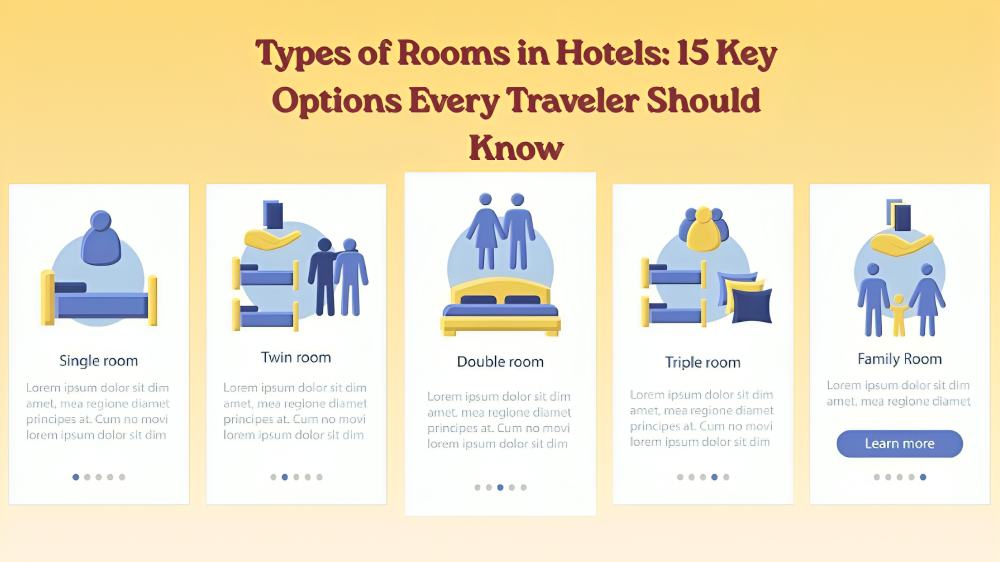
Picking the right hotel room changes everything about your stay. The bulk of travelers make hasty reservations without researching on what they are actually purchasing and that little oversight causes actual disappointment upon check-in. Whenever you travel alone, you have a partner with you, or you are with your entire family, knowing the Types of rooms in hotels can help you to conserve your cash and enjoy your tour to the fullest.
Hotels set functional categories on their rooms in the form of five items, which include: the number of guests that a room can accommodate, the type of bed that a room has, the layout arrangement, the amenities that are included and what the quality category of a room is. When you have a feel for all these areas, then all the booking decisions end up being a lot clearer and a lot easier to get on track.
Five Factors That Define Every Hotel Room
Hotels do not create room categories randomly. Instead, they design each type around specific guest needs and revenue goals. Therefore, we ought to know the five classification factors that define all the selections you will encounter on a reservation site before delving into the various room types.
| Factor | What It Covers |
| Occupancy | Number of guests the room holds |
| Bed Type | Size and number of beds |
| Layout | How the space is divided |
| Amenities | What extras come with the room |
| Luxury Tier | Overall quality and service level |
These five factors work together. The costs of a sea view double room are higher than a normal two-bed room again due to the added value of the view rather than the beds. Equally, a junior suite is as expensive as a double room since it offers a larger space to use.
15 Types of Rooms in Hotels You Should Know Before Booking
Before the booking platform opens and you commence price-comparing, it is good to know precisely what each of the room categories entails. Hotels have mismatched names and descriptions in their listings, and it is easy to have the wrong item on your reservation. A clear-cut breakdown of the most common types of rooms in hotels, from the simplest single, all the way to the presidential suite, is beneath the line so you can find the correct room for your actual travel requirements.
Single Room: The Right Fit for Solo Travelers
One room accommodates one customer and normally has one twin bed or one small double. It includes more than essentials, a personal bathroom, a bed, and a space that can accommodate a single person and luggage. This type of room is mostly used by solo business travelers and more cost-conscious tourists.
Among the things worth knowing about hotels is that the cost of a single room with a double bed is commonly somewhat more than that of a single room that has a twin, without much difference in size, both are supposed to accommodate one person. In case you only have to get a good night’s sleep and a place to leave your bags, the twin version can save you money, without any reduced comfort level.
Double Room: The Most Common of All Types of Rooms in Hotels
The double room tops the list as the most available room type globally. It accommodates two occupants and is available in two basic configurations: a bigger bed for two couples or two twin beds for two friends or co-workers. Such a distinction is much more important than most people would anticipate.
Travelers make regular bookings in a double room, expecting that they would receive one big single communal bed, only to get two singles. To prevent this, you should always select your type of bed when you are making the reservations, instead of not specifying it. In North America, the hotels default to queen or king beds, although most European and Asian hotels are skewed towards twin beds unless otherwise specified.
Even some hotels have a special Twin Room. Even though most booking sites consider a twin room as a double room, a twin room has two individual single beds. This arrangement is especially suitable for friends, colleagues, and traveling groups who would like to sleep separately.
Triple Room and Quad Room: Smart Picks for Small Groups
A triple room holds three guests through a double bed plus a single bed, or three separate singles. A quad room holds four guests, almost always with two double beds. Both types exist to keep groups together without the cost of booking two separate rooms.
However, not every hotel builds these as proper purpose-designed spaces. Some properties simply roll an extra bed into a double room and call it a triple. Before you confirm your booking, always ask whether the third or fourth bed is permanent or a rollaway addition. That detail matters especially when children are in the group.
Junior Suite vs Hotel Suite: A Clear Breakdown
The two types of rooms keep on confusing the travelers and confusion costs money. The decisive difference is reduced to one factor, whether there is a door that divides the bedroom and the living space or not.
A junior suite keeps both areas in one open space. The space is bigger than a regular double, typically 40-60 square meters, and does not seem as enclosed and cramped. A hotel suite will go the extra mile and provide you with a fully empty bedroom with a closed door. The said separation can be especially beneficial when one of the guests wishes to sleep when another is working or viewing TV.
| Feature | Junior Suite | Hotel Suite |
| Separate bedroom door | No | Yes |
| Layout style | Open plan | Fully divided |
| Typical size | 40–60 m² | 55–100 m² |
| Best suited for | Couples, solo travelers | Families, longer stays |
Executive Suite: Built for Business Travel Needs
An executive suite is aimed at corporate clients who require more than a place to sleep. In addition to the additional space and a separate living environment, the real value is access to an executive lounge. That lounge usually comes with a free breakfast, evening alcohol and a more relaxed place to work as well as a concierge team.
The executive floor benefits of major hotel brands such as Marriott, Hilton, and Hyatt have enabled them to create a robust loyalty program. Business travellers become loyal to a particular property due to access to lounges, rather than due to the size of the room. Although the executive suite may not offer as many perks as other upgrades, it can prove to be a more viable daily value should your company reimburse you, as far as housing goes.
Presidential Suite: The Highest Tier in Hotel Room Types
The top of the ladder of categories of the room is the presidential suite. It nearly always has the top floor, a kitchen and several bedrooms and bathrooms, a dining room, and a maid. Certain properties include the additional perks of private elevators and added security.
The designation presidential is not regulated by any industry regulation regarding what a hotel can label presidential, therefore, it is loosely applied by certain hotels. In the actual luxury brands, such as Four Seasons, Aman and Ritz-Carlton, however, the presidential suite provides a complete residential experience. Las Vegas takes this to an extreme, the Empathy Suite at The Palms Casino Resort, designed by Damien Hirst, charges around $100,000 per night and stands as one of the most expensive hotel rooms in the world.
Family Room: A Practical Choice for Traveling Families
A family room goes beyond simply offering more beds. Family rooms can be designed well with the addition of built-in bunk beds instead of rollaway means, blackout curtain to accommodate the sleep schedules of various children, child- safe furniture, small refrigerator to keep baby food or snacks.
In resorts such as Bali, the Caribbean and Southeast Asia, it is the norm to have family rooms located close to the playground or children’s pools. Instead of basing it on what is described on the internet, it is better to make a call to the hotel to ensure that you are indeed getting what was promised in the description, to save a lot of frustration on the actual day of arrival.
Sea View, Mountain View, and Garden View Room Types
Hotels in scenic locations develop complete categories of rooms based on the window view. The prices of sea view, mountain view and garden view rooms are usually 20 to 40 percent higher than the inward or street facing rooms. The product you are paying for is the view itself.
Sea view is a broad term, however. Hotel photos are always taken in the most favourable of perspectives, whereas those taken by the guest on review websites are a far more truthful reflection. On the other hand, a garden view room is usually underestimated. These rooms look onto well-kept lawns at large resort estates and are generally significantly quieter than pool or street rooms.
Accessible Room: A Dedicated Hotel Room Category
A convenient room accommodates people who have disabilities or low mobility. Legal regulations of most nations such as the ADA in the United States, mandate particular design elements: roll-in showers, grab bars, wider door frames, lowered fixtures, and ample clear floor space to move a wheelchair.
There is still a big disparity between what the law states and what is really comfortable in many properties. Accessible rooms are now designed by forward-thinking hotel brands who use the same quality finishes and furnishings as in their premium quality standard rooms instead of considering accessibility as a back-of-the-napkin perfunctory consideration. You should always call the property and clarify details where you require all these features, as online booking pages often deprive you of certain important information.
How to Choose the Right Hotel Room for Your Stay
Getting the hotel room of choice does not just include mere price comparisons. The most appropriate one will be based on how many people will be traveling, the objective of your visit and the comfort that you are anticipating during your stay. The same room can be ideal for a single business traveler, but not for a family vacation or a long stay.
Before booking, consider these factors:
- Confirm how many guests will stay in the room.
- Check the exact bed configuration.
- Compare room size rather than relying only on photos.
- Review whether breakfast or lounge access is included.
- Consider the room view if it matters to your experience.
- Check cancellation policies and upgrade options.
Room size is the first consideration of many frequent travelers. Nonetheless, the type of bed, the position of the room, and the included services usually influence more comfort. Remembering to check such details by a few extra minutes can prevent the surprises at check-in.
Common Hotel Room Booking Mistakes to Avoid
Most tourists believe that there is no difference between classes of hotel rooms. However, hotels tend to employ various descriptions and arrangements and this can lead to confusion when making a reservation.
Some of the most common mistakes include:
- Booking a double room without confirming the bed type.
- Assuming a sea-view room guarantees an unobstructed ocean view.
- Ignoring room occupancy limits.
- Choosing the cheapest room without checking its location.
- Forgetting to verify whether extra beds are permanent or rollaway beds.
- Overlooking accessibility requirements until arrival.
Avoiding these mistakes can save money and improve your overall hotel experience.
Final Verdict: Choosing the Right Room Type for Your Trip
Knowing the types of rooms in hotels gives you real control over your booking. Each type has a purpose, and the only easiest thing to do is to adjust your purpose to your real needs to enjoy the maximum of your stay. An individual tourist does not require a quad room. There is no way a family of four would fit in a double. An executive suite is much more than an ordinary room upgrade to a business traveler on a long journey.
Ensure that the bed type and layout, including any special features, are confirmed with the hotel when those really matter. Read user reviews instead of using exclusive descriptions. These little details convert a good stay into a really good one, and they begin long before you open the door of the hotel.
Read more blogs: Front Office Software for Hotels: Complete Guide to Streamline Operations in 2026