
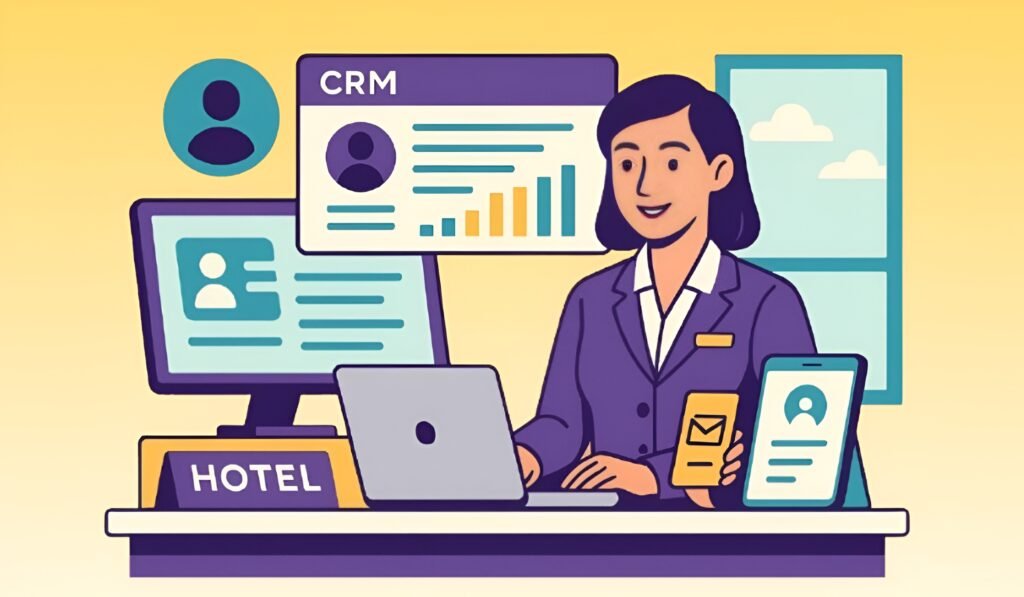
In the contemporary hospitality business, hotels are competing based on the luxurious room, the scenic location, as well as the quality of the guest relationships. Hotels that know their customers make better loyalty and increased revenues. This is precisely the point in which Hotel CRM will be necessary.
A Hotel CRM is a program which assists hotels to gather, arrange and examine guest information. Hotels do not keep the guest information in various systems, but they store all this information in a single location. Through this, the teams in a hotel become capable of comprehending the preferences of the guests, their booking patterns, and their communication history.
Due to this centralized information, hotels are able to provide personal experiences. The guests are given appropriate offers, timely communication and superior service during their stay. This means that customer satisfaction will improve and the operation efficiency will go up.
What Is a Hotel CRM and Why It Matters
The Hotel CRM is another term used to refer to Customer Relationship Management software tailored in the hotel industry. A system is used to store the specifics of the guests like booking history, record communication and preferences.
This information helps hotels to make interactions more personal at each point of the guest journey. As an example, when a guest wants a room on a high floor or vegetarian meals, then the hotel staff can make them ready in advance. As a result, they make the guests feel appreciated and heard.
Moreover, a Hotel CRM assists marketing departments to conduct specific campaigns. Hotels are able to group guests into various groups as opposed to initiating the same message to them. Completely different offers might be given to the families, business travelers and honeymoon couples.
Automation is another essential benefit. The system will be able to automatically dispatch booking confirmation, pre-arrival email and post-stay feedback request. Consequently, employees will have less time of doing the same tasks and more time of enhancing staff service.
Key Benefits of Using a Hotel CRM
Hotels are competitive in their nature and thus they have to develop memorable guest experience. A Hotel CRM has the means to do this.
The first is that it enhances the satisfaction of the guests. Hotels are able to offer personalized service without any problem when they know the preference of guests and their previous behavior. This attention to detail is welcome by the guests and this further enhances the chance of returning as customers.
Second, it assists in improved marketing approaches. Guest data can be analyzed by marketing teams, and campaigns can be designed on the basis of the actual insights. Due to this marketing will be more efficient and the rate of conversion will be higher.
Third, it enhances the efficiency of operations. Hotel CRM automation saves time and effort by the hotel employees. Email campaigning, reminders, and follow-ups do not have to be monitored constantly.
Core Features of a Hotel CRM System
All modern Hotel CRM provide complex of the main functions that assist in the work of managing relations with guests. These characteristics convert raw data into insights.
Guest Profile Management
The system develops elaborate guest profiles that contain preferences, booking history and record of communications. This information is accessible to the staff members in real-time.
Marketing Automation
With automated email campaigns, hotels can use the automated methods to send promotions, newsletters, and booking reminders without manually doing it.
Audience Segmentation
Hotels can segment the customers on the basis of demographics, travelling habits or interests. Consequently, marketing campaigns are focused and effective.
Data Analytics and Reporting
A Hotel CRM studies the behavior of the guest and the performance of the campaigns. This information assists managers to make well-informed decisions.
Interconnection with Other Systems
The system is usually combined with Property Management Systems (PMS), reservation engines and email applications. As such, hotels are able to handle all operations in a more efficient manner.
How a Hotel CRM Works in Daily Hotel Operations

To appreciate its worth, it would be prudent to examine the Hotel CRM in the daily activities. The system gathers information through various channels including online bookings and web forms and customer contacts.
The platform structures the collected data into organized guest profiles after gathering the data. Such profiles will enable hotel staff to know more about each customer. As an illustration, they are able to see previous reservations, inclinations, and reviews.
The system then analyses and finds useful patterns in the data. Hotels are able to determine the marketing campaigns that have the great majority of bookings or what services are favored by the guests.
Subsequently, workflow starts to be automated. A customer booking a room can get a confirmation mail on the spot. Reminder email could come prior to the stay. A survey about the guest may be given out to him after the checkout.
Due to such automated systems, a Hotel CRM makes sure that each interaction with the guest is prompt and topical.
Comparison of Hotel CRM Benefits for Hospitality Businesses
The following table highlights how hotels benefit from CRM technology.
| Feature | Without CRM | With CRM |
| Guest Data Management | Scattered across systems | Centralized in one platform |
| Marketing Campaigns | Generic messaging | Personalized campaigns |
| Guest Communication | Mostly manual | Automated and timely |
| Customer Insights | Limited data | Detailed analytics |
| Guest Loyalty | Hard to maintain | Strong relationships |
As the table shows, a Hotel CRM dramatically improves how hotels manage relationships and marketing strategies.
How Hotels Use Hotel CRM for Marketing and Revenue Growth
Marketing contributes immensely to the success of the hotel. It allows marketing groups to have access to powerful tools that can assist them in attracting and retaining guests with a Hotel CRM.
The first strength is the segmentation of the audience. Hotels could classify customers in terms of their travel motive, place, or frequency of booking. Due to such segmentation, marketing messages will be more relevant to every audience.
The other effective application is individualized email marketing. A frequent customer can be offered a loyalty discounted price whereas a new customer can be offered an introductory price. These focused campaigns enhance the level of booking conversion.
Also, hotels have the ability to monitor the performance of campaigns. The analytics software within Hotel CRM displays open rates, click rates and conversion rates of booking. Thus, marketers will be able to shape their approaches up.
Choosing the Right Hotel CRM for Your Property
The choice of an appropriate CRM system is to be considered. The needs of various hotels vary based on the size of the hotel, target market, and business model.
First, hotels need to consider the ease of use. A Hotel CRM should have a very easy interface such that staff will be able to use it without having to be highly trained.
Second, it is concerned with integration capabilities. The CRM is expected to be easily linked to the booking engine of the hotel, PMS and marketing tools.
Third, it should have reporting capabilities. Hotels must have clear indicators to gauge the success of the campaign and the attention of the guests.
Fourth, it is important in scalability. It is possible that a small boutique hotel can begin with simple features, although the system is supposed to expand with the business.
Future Trends of Hotel CRM Technology
Hospitality industry is one that keeps on changing at a high rate. Consequently, new innovations are also made in the CRM technology.
The feature of artificial intelligence is emerging. AI will be able to analyze big data and predict the preferences of guests more precisely. Thus, hotels will be able to provide even more personal experiences.
The other emerging trend is mobile integration. Most CRM systems currently enable hotel managers to retrieve the information about guests using mobile devices. This is flexible, which enhances responsiveness and decision-making.
Also there will be continued expansion in automation. More marketing processes and operations will be automated in future. As a result, hotels will become more efficient and enhance the service quality.
Conclusion
Guest relationships and memorable experiences of the guests are the staple of the hospitality industry. Hotels that know their customers have a greater loyalty and are more profitable.
Hotel CRM helps hotels to gather meaningful information about the guests and process it in an efficient way and convert insights into experiences. Hotels enhance marketing initiatives and operational efficiency through automation, segmentation and data analytics.
Moreover, the technology enables the hotels to stay in touch with the customers at all times before, during and after they have stayed. This constant interaction builds trust and brings back visitors.
Also Read About :- Hotel PMS and Channel Manager