
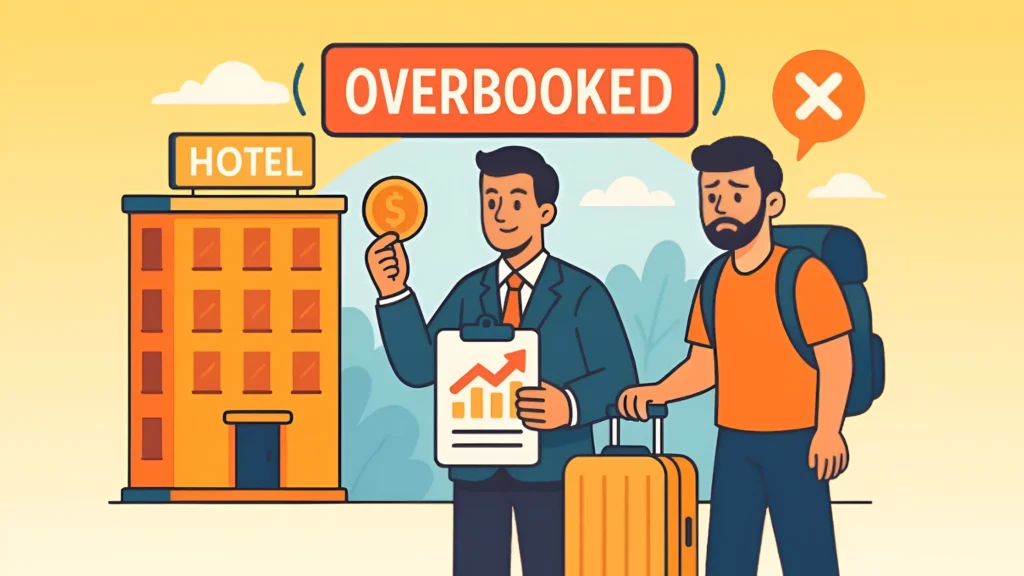
There has always been controversy over overbooking in hotels. Other managers refer to it as risky, and some refer to it as essential. Nevertheless, there is one thing that is evident, an Hotel overbooking strategy when applied in a proper manner assists hotels in safeguarding revenue, raising occupancy, as well as lowering losses, which occur due to cancellations as well as no-shows.
Simultaneously, ineffective performance harms reputation and loyalty of the guests. Thus, the use of this tactic by hoteliers should be done in a careful, strategic, and responsible manner.
This step-by-step guide will help you understand what Hospitality Hotel overbooking strategy is all about, the reasons why hotels employ it, its advantages and disadvantages and how to implement it effectively in the modern data-driven world.
What Is Hotel Overbooking Strategy?
Hotel over booking strategy refers to selling more rooms than the hotel can actually occupy on a particular date. The reason why hotels do this is due to the fact that they are aware that the following guests will cancel late, miss or will not turn up or check-out.
This method will be based on forecasting as opposed to accidental double bookings occasioned by the failures of the system. Revenue managers use the historical data, cancellation patterns, seasonality and booking patterns. They make that decision based on such information and thus determine the number of additional rooms they can safely sell.
To take an example, when a hotel with 100 rooms records 5 no-shows on average, the management can sell 103-105 rooms. When the forecasts are correct, the hotel will not have vacant rooms since it will achieve full occupancy.
Hotel rooms are perishable products, which means that as soon as the night is passed, the income possibility is lost forever. Hotels therefore have overbooking to cushion against profit margins.
Why Hotels Use a Hotel Overbooking Strategy
Hotels are in an environment where the daily revenue is influenced by uncertainty. Guests cancel flights. Meeting rescheduling among business travelers. Weather changes plans. This results in last minute gaps in hotels.
The absence of Hotel overbooking strategy will make the properties lose thousands in potential sales monthly.
There is also competition in the market, which compels hotels to achieve occupancy. Empty rooms are costly due to high fixed expenses such as personnel, utility and maintenance costs. Even slight growth in occupancy will enhance profitability.
Thus, regulated overbooking is financial insurance against erratic guest behavior.
Intentional vs. Accidental Overbooking
Understanding the difference between planned and accidental overbooking remains critical.
Intentional Overbooking
Intentional overbooking relies on forecasting tools and historical trends. Revenue managers calculate expected no-show percentages and add a small buffer of extra bookings.
This method requires:
- Reliable PMS data
- Real-time inventory tracking
- Strong forecasting tools
- Clear contingency plans
When executed correctly, it supports revenue growth without harming guest experience.
Accidental Overbooking
Overbooking occurs accidentally due to system failure, human error, or channel disconnection. As an example, when the channel manager does not match inventory among OTAs, the hotel can end up selling one room twice.
This is a frustrating scenario that destroys confidence. Thus, the use of technology is one of the key factors to avoid oversells by mistake.
Key Benefits of a Hotel Overbooking Strategy
Overbooking provides quantifiable benefits when it is done in a professional manner.
1. Minimized Revenue Loss
Cancellations hurt margins. Strategic overselling alleviates that risk, however. The hotel is able to have occupancies of closer to 100 percent rather than having rooms that are not sold at the end of the day.
The increased revenue of several more occupied rooms per night is very high.
2. Higher Occupancy Rates
Since rooms are only profit making when occupied, occupancy maximizes financial performance. Hotels that are well-placed in terms of forecasting will be in the position to sell more than what is in safe boundaries.
This leads to an improvement in profit margins particularly when seasons are in high demand.
3. Forecastable Revenue Management
The contemporary revenue systems examine booking windows, cancellations, and guest behavior. As such, decisions are based on facts and not intuition.
Structured forecasting makes Hotel overbooking strategy a revenue tool which is controlled and not a gamble.
4. Competitive Advantage
Hotels that do their inventory smartly beat the competition that fears to over-sell. Most others miss revenue through empty rooms whereas strategic properties do maximize returns.
Risks of Hotel Overbooking
Although it has its advantages, overbooking has actual dangers. Managers should be aware of them.
Negative Guest Experience
Guests do not like to be told that the room is not available when they come and have a reservation. This trust is destroyed at this moment.
When staff members do a bad job in managing the situation, the guest can leave negative reviews or simply never go back.
Reputation Damage
Reviews are very influential in the digital age during booking. A single complainant in viral form will affect hundreds of potential reservations.
That is why, hotels should manage the walk situations in a professional and compassionate way.
Operational Stress
Front desk staff have a lot of pressure when they have to move customers. The stress levels are even more elevated during peak seasons.
In the absence of adequate training and SOPs, there is a drop in service quality.
Legal Considerations
Confirmed reservations are contractual in most areas. In case they are unable to keep the bookings, hotels are obliged to refund the prepaid amounts and provide similar accommodation.
Knowing the local laws will guard hotels against courtroom battles.
Should Every Hotel Use a Hotel Overbooking Strategy?
Not necessarily. It should only be adopted by hotels that have sound systems, personnel and have an effective contingency plan.
Small properties that lack forecasting tools might have difficulties in estimating the safe overbooking limits. In the meantime, hotels that are not linked together face the danger of making accidental oversells.
Thus, preparation is what makes one fit.
Hotel Overbooking Strategy: How to Create a Safe and Profitable Plan

A well-laid plan will change the overbooking as a behavior to risky behavior into a revenue planning strategy.
Use Data for Accurate Forecasting
Determine the historical rates of cancelations by season, day of the week, and booking channel. Identify patterns. As an illustration, corporate bookings can be characterized by a decrease in no-show rates as compared to OTA bookings.
Then compute a comfortable overbooking level.
Maintain Real-Time Inventory Control
Make sure your PMS, booking engine and channel manager can be synchronized in real time. Accidental overselling is avoided by real time updates.
Inventory errors are well decreased by cloud based systems.
Identify Priority Guests
Do not walk loyal, high paying, or VIP guests. Rather, consider the reservation type, booking guarantee, and the guest history and make the relocation decisions.
Secure long term relationships first.
Establish Partnerships with Nearby Hotels
Premeditated contracts with hotels of the same kind facilitate the move. During times of need, employees will not have to scramble to provide alternative accommodation.
This model of partnership prevents the guest experience.
Standard Operating Procedures for Overbooking
Clear SOPs reduce confusion and protect service standards.
Include:
- Forecasting rules
- Communication scripts
- Compensation guidelines
- Escalation procedures
- Post-incident review steps
Consistency ensures professionalism even under pressure.
Staff Training and Guest Communication
Front desk teams must handle difficult conversations calmly and confidently.
Train staff to:
- Apologize sincerely
- Offer clear explanations
- Present solutions immediately
- Provide compensation confidently
Empathy matters more than technical explanation. Guests respond positively when staff demonstrate genuine care.
Compensation Planning
Define compensation policies before issues arise.
Options may include:
- Covering the first night at a partner hotel
- Providing transportation
- Offering loyalty points
- Issuing future stay discounts
- Upgrading future reservations
Pre-approved options empower staff to resolve issues quickly.
Technology’s Role in Modern Overbooking
Technology strengthens strategic execution.
| System | Function | Impact on Overbooking |
| PMS | Tracks live inventory | Prevents accidental oversell |
| Channel Manager | Syncs OTA availability | Reduces double bookings |
| Revenue Tool | Forecasts demand | Calculates safe oversell limits |
| CRM | Identifies loyal guests | Protects VIP relationships |
Integrated systems transform the Hotel overbooking strategy into a precise revenue management technique.
Hotel Overbooking Strategy in Peak Seasons
Peak demand increases risk but also increases opportunity.
During high-demand events, cancellation rates may drop. Therefore, managers must adjust oversell levels accordingly.
Relying on outdated data during major festivals or conferences can backfire. Instead, monitor booking pace daily and adjust inventory dynamically. Agility ensures balance between risk and reward.
Continuous Review and Improvement
Successful hotels treat overbooking as a living strategy.
After each incident, analyze:
- Walk rate
- Guest feedback
- Financial impact
- Staff response efficiency
Refine forecasting models accordingly. Continuous improvement reduces long-term risk.
Final Thoughts on Hotel Overbooking Strategy
One of the most effective strategies in hotel revenue management that is not very clear is overbooking. When it is employed in disorganized ways, it results in broken trust and reputation. But with proper forecasting, combined technology, and skilled personnel, it will maximize occupancy and increase profitability.
The Hotel overbooking strategy never ought to be a guesswork. Rather, it must be a data-driven, well-observed system with well-defined SOPs and effective communication.
After all, it is simple, fill rooms and not lose loyalty.
Those hotels that will keep flourishing in competitive markets are those that maximize the income without compromising the satisfaction of guests.
Also Read About:- Types of Services in Hotel: Creating Exceptional Guest Experiences